
Service Strategy
Service Strategy – this is the foundation of the service lifecycle. Its purpose is to define a strategic approach to managing services throughout their entire lifecycle. To deliver a service, it is necessary to have a clear understanding of the business outcomes it is intended to deliver. Only then can the service be successfully managed.
The objectives of a Service Strategy are:
- Understanding what a strategy is;
- Identifying all Stakeholders;
- Understanding how the Service will be implemented and delivered;
- Providing tools for identifying Service Delivery opportunities;
- Providing a service model that describes who will benefit from it, how it will be paid for, and the goals it will achieve;
- Understanding the resources required to provide the service;
- Defining the processes and services required to implement the Service;
- Defining customer requirements, as well as the relationship between the customer and the Service Provider.
What is provided to businesses?
- The ability to link the Service Provider actions to the business’s desired outcomes. The Customer (business) and the Service Provider should not view a service simply as a set of activities designed to generate profit! A service should also be viewed as a means to increase profits from other organizational processes and procedures.
- The ability to provide a Service that will help the business organize its processes;
- The ability to obtain a Service that quickly adapts to business changes;
- The ability to create a Service Portfolio that reflects the overall potential for achieving a positive Return on Investment, ROI;
- Foster communication between the Service Provider and the Customer, which facilitates an understanding of the service requirements;
- Understanding the feasibility of organizing work to provide the exact service needed.
Value of Service
Value of Service is the level of service that meets the customer’s needs. The cost of a service is determined by how much the Customer is willing to pay for it, not by how much it takes to deliver it. Value of Services isn’t always measured by profit; it can also be measured by what the Customer can accomplish with them.
Value of Service are:
- determined by the customer;
- an acceptable combination of features. The Customer selects those services that offer the best balance of cost and features;
- the achievability of goals. A Service may be valued not in terms of the profit it will generate, but in terms of its unique results;
- those that can vary depending on various conditions.
The Service Provider must understand:
- Value of Service, the Customer must associate it with something measurable. For example, if high-quality email access is important to the Customer, metrics for measuring this must be defined (e.g., the ratio of successful transactions to the total number of email transactions);
- The Customer must understand what they will receive from the Service;
- The Cost Of the Service is a key metric characterizing the Service and should be determined by the Service Provider.
Based on all of the above, it’s up to the Customer to determine the Value of Service, weighing the Cost Of the Service itself against the benefits they’ll receive from it. However, the following factors will also influence the customer’s decision:
- Business Results;
- Perceptions of what should be achieved. This is influenced by a large number of factors, ranging from the customer’s familiarity with similar services and the knowledge and skills of the staff to corporate culture and policies. Perceptions of the expected Service shape the customer’s preferences regarding the service;
- Customer Preferences. These determine how the Service should look.
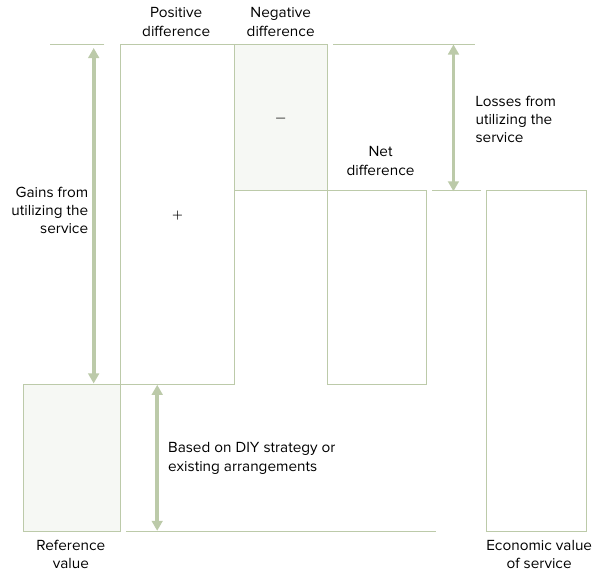
What about the economic evaluation of the service? This is the most pressing question for management: will the Service be economically justified? Its calculation can be tracked through the following steps:
- Reference Value. This calculation can be based on anything, such as information from companies already using a similar service;
- Positive Value. This estimate should be made by the Customer, as it will be largely based on corporate information. This estimate includes the value the customer will receive if they use the Service;
- Negative Value. This estimate can be made jointly with the Service Provider. This estimate includes all costs associated with using the service;
- Net Difference. The difference between the Positive and Negative values;
- Economic Value of Service. This represents the full value of the service, as perceived by the Customer. To a large extent, it is measured not so much by economic profit (Net Difference) as by the results of the Service, which determine the Value of Service.
Utility and Warranty
Any service is defined by these two key indicators.
Utility defines the functionality of a product or service as defined by customer requirements. It answers the questions “What does the service do?” and “What is it for?”.
Warranty formalizes the assurance that the service complies with the agreed-upon agreements (e.g., a contract or Service Level Agreement, SLA). It characterizes the service as being available when needed.
The combination of these two key characteristics determines the quality of the Service itself. A service is delivered using the Assets of the parties (the Customer and the Service Provider). The terms that make up Assets are presented below.
- Resources. These are the various inputs to service delivery. These include money, people (such as personnel), infrastructure, software, information, etc.
- Capabilities. These determine the organization’s ability to provide a service. These include managerial and organizational capabilities, processes, accumulated knowledge, and people (such as experience and expertise).
- Assets. These are everything owned by the organization. They include Resources and Capabilities, forming relationships between them. Thus, Resources cannot provide services without the necessary Capabilities, and vice versa.
Governance
Governance is the area where IT and business cooperation, collaborating based on policies, guidelines, and rules to achieve desired results.
It’s important to remember that no standard is a single solution; they merely serve as a toolbox of possible organizational solutions. Corporate rules, to which standards must be adapted.
Risks
The Service Strategy includes risk management. Risk management is carried out in the following sequence:
- Identify Risks. Should be as broad as possible, encompassing all aspects, including financial, human, organizational, technical, and other. The more risks identified, the easier they will be to manage and the lower the cost of the service. Identify Risks process can involve various Stakeholders and knowledge. Once a risk is identified, it should be entered into a special Risk Register for further management.
- Risk Analysis. Conducted to understand the need for risk monitoring. The analysis is performed in two stages: Qualitative and Quantitative. Qualitative Risk Analysis is characterized by a description and special notes regarding the risk, while Quantitative Risk Analysis is characterized by the ratio of the probability of risk occurrence and the indicator of the damage it can cause to the service (if this value is equal to 100, then this is not a risk, but a fact; if it is equal to 0, then this is not a risk, since this risk will not have any impact on the service and, therefore, should be excluded from the Risk Register). After the risks are assessed, the Risk Register should be updated.
- Risk Management. The responsibility of the manager, as well as all participants in the Service Delivery process (primarily the Service Provider), is to prevent the occurrence of negative risks and respond to them if prevention is impossible. In addition to risk monitoring, it is necessary to continue risk identification and assessment.
Pattern of Business Activity, PBA
As a rule, when performing operational activities, the operations necessary for it are of the same type and over time acquire an increasingly ideal form. To do this, a business uses its Resources, such as money, people, infrastructure, etc. Once the iterative process has been identified (this will be the Pattern of Business Activity, PBA), it needs to be documented. At the same time, it will have the following characteristics:
- Classification. A definition of a type that can refer to a source (user or other entity), its result type, or a Workload.
- Attributes. Any type of characteristic—for example, execution frequency, location, duration, etc.;
- Requirements. Includes requirements for performance, security, privacy, latency, etc. Some of these characteristics describe the Warranty;
Service Assets. Used to estimate the necessary Resources and Capabilities that the Service Provider and the Customer must possess to provide a Service that meets the requirements.
A Pattern of Business Activity, PBA is necessary for a Service Provider to understand the Workload of a given business process at a given time. This is essential for service planning, design, and delivery.
Service Portfolio
This is the complete list of services managed by a Service Provider. It may include the management of ongoing contracts and financial agreements with other Suppliers and Customers; activities to create new services; and initiatives to improve existing services. It may include any services managed by the company, from those visible to the customer to Enabling Services.
It consists of three sections: Pipeline Services – those services that are only being prepared for implementation and operation, as well as those services that are in the concept development stage; Service Catalog – services that are “visible” to the Customer, Core Services; Retired – services that for one reason or another have been excluded from the provided services.
Using the Service Portfolio, you can understand which services require additional resources and reallocate them from other services, or determine whether they are necessary. You can also monitor the costs of specific projects (if they are implemented in accordance with any known methodologies, such as PMI).
Every service in the Service Portfolio must be measurable, i.e., have some characteristic that describes its state. Moreover, for each stage of the service lifecycle, this characteristic may change. For example, at the Design stage, this characteristic will be the percentage of service development complete, and at the Operation stage, it will be the number of successfully completed operations.
The Service Portfolio needs to be managed, and this is what we will discuss below.
Service Portfolio Management
The purpose of this process is to ensure that the services you manage meet customer requirements and satisfy their interests. The Service Portfolio should tie each service to a specific business goal—this will make the service justifiable. Moreover, the approach to this tie may differ for External and Internal Customers: for Internal Customers, it will be necessary to work directly with organizational units; for External Customers, the tie will be defined in the contract, which will serve as the foundation for all relationships.
Goals of Service Portfolio management
- Define the overall direction of service development based on potential benefits and acceptable risk;
- Provide an up-to-date Service Portfolio – each service should be aligned with business objectives;
- Provide information on how services will contribute to achieving business objectives and how services will be modified in the event of changes in the organization’s external or internal environment;
- Monitor the services provided;
- Track all managed services throughout their lifecycle;
- Provide information on the status of a service and when a service can be removed from the Service Catalog.
Financial Management Process
This process is very important, especially for the organization’s management, as it allows for an assessment of the effectiveness of each department. The IT Service Provider should be involved in this process and contribute to improved financial management.
Goals
The IT Service Provider manager is responsible for maintaining the appropriate level of funding for services needed to maintain them at the required level. This, of course, requires finding a “golden mean” between service quality and cost.
Basic financial management rules (e.g., reporting format, application format, rules for financing activities, cost assessment, etc.) should be taken from corporate financial management rules. These are developed by the company’s finance (or accounting) department. At the same time, IT financial management may have some specific features that should be defined in organizational documents!
Financial Management consists of three main processes:
- Budgeting. This process is responsible for the projected calculation of costs and profits. It is characterized by periodic cycles (annual planning), resulting in a budget for the nearest estimated period;
- Accounting. This process accounts for funds already spent over a specific time period. It is important to note that accounting must be accurate and reflect all expenses, taking into account all the nuances and specifics of IT accounting. It is advisable to have this process performed by a financial reporting professional or an accountant familiar with the relevant methods and tools.
- Charging. This is perhaps the most enjoyable process – it involves providing invoices to the client for services provided. It requires skills and specialized software, so it is typically performed by finance departments.
As mentioned above, Financial Management is a cyclical process, below are two types of cycles:
| Budgeting | Accounting | Charging | |
|---|---|---|---|
| Planning (Annual) | Calculating expected costs | Estimating the cost of each IT resource |
Setting pricing policies and specifying service costs |
| Operational (Monthly) | Control of budget changes | Cost control | Invoicing and payment acceptance |
Financial Management tasks
- Defining, developing, and maintaining a financial model that will enable the Service Provider to effectively identify new services and manage existing ones;
- Assessing the impact of changes to the organization’s existing business processes;
- Protecting the funds necessary to provide services;
- Performing simple financial controls over revenue and expenses and ensuring that they are implemented in accordance with the organization’s requirements;
- Maintaining reporting and cost management;
- Adhering to the organization’s accepted financial management procedures and rules;
- Ensuring that funding is used to create, deliver, and maintain existing services;
- Preparing financial forecasts.
Business Case
A Business Case is a decision-making tool for business planning and management. It can be either qualitative (description) or quantitative (cost indicator). Management is typically interested in quantitative justification, the most prominent example of which is financial analysis.
May consist of:
- Introduction. A brief description of the initiative (in our case, a service) and its objectives;
- Methods and Assumptions. A list of the initiative’s (service’s) limitations, a description of its scope, and methods for calculating the Business Case;
- Impact. A description of the initiative’s impact on the organization’s operations, both financial and otherwise (which, by the way, can often be expressed in monetary terms);
- Risks. A list of the initiative’s negative and positive risks.
- Recommendations. Various recommendations and links.
Regardless of the principles used to formulate a Business Case, it must describe the business goals it plans to achieve. Depending on the organization’s strategic goals, it is necessary to select business objectives for new initiatives (including IT).
The impact on the organization is somewhat more complex – the impact of providing services is quite difficult to assess from a financial perspective. For this reason, the Business Case should describe both the financial and non-financial impacts on the organization.
Business Relationship Management
At first glance, this process may seem unnecessary and only adds bureaucracy, but ITIL developers believe that professional service management requires developing a strategy for interaction between the Service Provider and the management of the service customer.
Goals
- Establishing a relationship between the business and the Service Provider, and maintaining it at a level necessary for the comfortable provision of high-quality services;
- Identifying customer service requirements and determining whether the Service Provider can fully implement them. This process is also responsible for tracking changes in requirements and the Value of Service.
- The Service Provider must monitor service delivery and, on the one hand, not surplus work not specified in the contract, even if it receives gratitude from the customer, but at the same time, they must meet the customer’s expectations for which they are willing to pay.
Business Relationship Management tasks
- Ensure the Service Provider understands the customer’s interests in the Core Services provided, with the ability to align them hierarchically;
- Achieve maximum satisfaction with the services provided;
- Ensure effective communication between the customer and the Service Provider, ensuring the latter’s ability to adapt to various changes within the customer’s organization;
- Ensure that the Service Provider clearly understands the customer’s requirements;
- Provide mediation in resolving various types of conflicts;
- Establish a formal procedure for submitting complaints and suggestions from the customer;
- Understand how services should be provided in accordance with the customer’s requirements.
To do all this, you will need to understand:
- Results. Understand what needs to be achieved;
- How the Customer intends to use the services – understand the business processes with which Core Services will interact;
- Understand how services are managed (service level, quality, and cost management);
- It is necessary to measure the level of services provided and respond to changes;
- How to optimize Service Delivery in the future.
It’s important to understand that no single process operates independently; on the contrary, they are all closely interconnected. The same applies to Business Relationship Management – it can not only utilize information from other processes but also influence them. However, this requires a clear understanding of the service boundaries, outcomes, and other information.