
Abstract
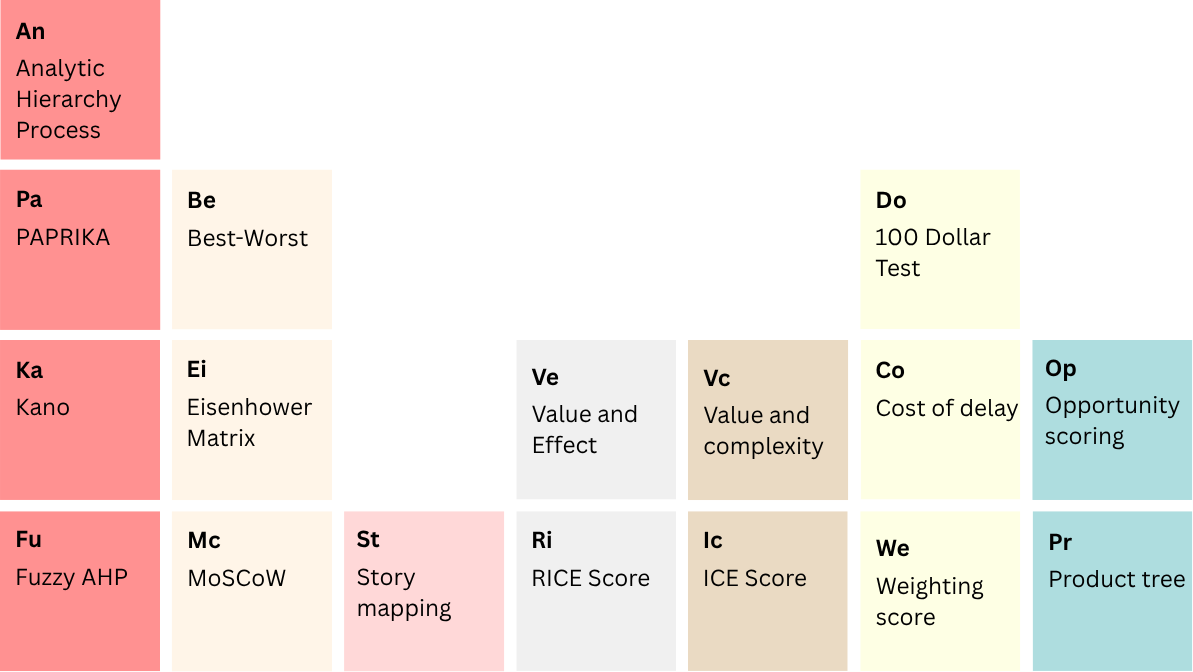
Prioritization is critical for determining the sequence of decisions. There are many methods for setting priorities. Some of them will be discussed below.
For simplicity, all prioritization methods will be discussed using the example of selecting task implementations and determining the sequence for their implementation. Let’s assume that Project P has several tasks, and the project team is assigned four tasks: Task A, Task B, Task C, and Task D.
Analytic Hierarchy Process

We should begin with a method that is also highly popular and has been rated as the most effective. This tool’s effectiveness belies its complexity.
Analytic Hierarchy Process использует математический подход для выстраивания приоритета задач по шкале значимости. Для оценки потребуется выделение трех компонентов: Goal - итоговая цель; Criteria - факторы, влияющие на Goal; и Alternatives - существующие альтернативы.
The Analytical Hierarchy Process uses a mathematical approach to prioritize tasks based on their importance. The evaluation requires identifying three components: Goal (the ultimate goal); Criteria (the factors that influence the Goal); and Alternatives (the existing alternatives).
AHP steps
- Identify the problem.
Example: Choosing a tasks priority
Prepare an evaluation platform. It should include: Goal - the problem itself; Criteria - how we will evaluate (by what criteria) the impact of the choice option on the Goal; Alternatives - the options themselves.
Define the Criteria set. List the Criteria that are most important for achieving the Goal.
Example
Criterias = Complexity (C), Schedule Index (SI), Earned Value Index (EVI), Importance (I)
- Perform a pairwise comparison of criteria. The goal of this step is to determine the weight of each Criteria relative to the Goal. Each Criteria is compared to another Criteria, forming a matrix. Then, by simply adding the values together, the weight of each Criteria can be calculated for the upcoming assessment.
Example
Let’s assume that the Comparison Matrix for Criteria looks like this:
| C | SI | EVI | I | |
|---|---|---|---|---|
| C | 1 | 1.27 | 0.69 | 1.38 |
| SI | 0.79 | 1 | 2.21 | 1.18 |
| EVI | 1.45 | 0.45 | 1 | 2.08 |
| I | 0.72 | 0.85 | 0.48 | 1 |
It’s important to note how these values are obtained—they are the result of an analytical comparison of the relationship between one criterion and another. The figure can be obtained in various ways, including expert assessment, analysis of scientific papers, etc.
- Calculate the weight of the Criteria. How does the criterion influence the achievement of the Goal?
Example
There are several methods, below 2 of them will be proposed (additional: Largest Eigenvector Method, Fuzzy Geometric Mean Method).
5.1. Eigenvector Vector Weighting Method
5.1.1. Columns arithmetic summary
| C | SI | EVI | I | |
|---|---|---|---|---|
| C | 1.00 | 1.27 | 0.69 | 1.38 |
| SI | 0.79 | 1.00 | 2.21 | 1.18 |
| EVI | 1.45 | 0.45 | 1.00 | 2.08 |
| I | 0.72 | 0.85 | 0.48 | 1.00 |
| Summ | 3.96 | 3.57 | 4.38 | 5.64 |
5.1.2. Columns normalization
| C | SI | EVI | I | |
|---|---|---|---|---|
| C | 1.00/3.96=0.25 | 1.27/3.57=0.35 | 0.69/4.38=0.16 | 1.38/5.64=0.24 |
| SI | 0.79/3.96=0.20 | 1.00/3.57=0.28 | 2.21/4.38=0.50 | 1.18/5.64=0.21 |
| EVI | 1.45/3.96=0.36 | 0.45/3.57=0.13 | 1.00/4.38=0.23 | 2.08/5.64=0.37 |
| I | 0.72/3.96=0.19 | 0.85/3.57=0.24 | 0.48/4.38=0.11 | 1.00/5.64=0.18 |
| Summ | 1 | 1 | 1 | 1 |
5.1.3. Arithmetic mean
| C | SI | EVI | I | Criteria Weight | |
|---|---|---|---|---|---|
| C | 0.25 | 0.35 | 0.16 | 0.24 | (0.25+0.35+0.16+0.24)/4=0.25 |
| SI | 0.20 | 0.28 | 0.50 | 0.21 | (0.20+0.28+0.50+0.21)/4=0.30 |
| EVI | 0.36 | 0.13 | 0.23 | 0.37 | (0.36+0.13+0.23+0.37)/4=0.27 |
| I | 0.19 | 0.24 | 0.11 | 0.18 | (0.19+0.24+0.11+0.18)/4=0.18 |
| Summ | 1 | 1 | 1 | 1 | 1 |
5.2. Geometric Mean Weighting Method
5.2.1. Column geometric mean
| C | SI | EVI | I | Geometric mean | |
|---|---|---|---|---|---|
| C | 1.00 | 1.27 | 0.69 | 1.38 | (1.00*1.27*0.69*1.38)^(1/4)=1.05 |
| SI | 0.79 | 1.00 | 2.21 | 1.18 | (0.79*1.00*2.21*1.18)^(1/4)=1.20 |
| EVI | 1.45 | 0.45 | 1.00 | 2.08 | (1.45*0.45*1.00*2.08)^(1/4)=1.08 |
| I | 0.72 | 0.85 | 0.48 | 1.00 | (0.72*0.85*0.48*1.00)^(1/4)=0.74 |
| Summ | 3.96 | 3.57 | 4.38 | 5.64 | 4.06 |
5.2.2. Rows normalization
| C | SI | EVI | I | Geometric mean | Criteria Weight | |
|---|---|---|---|---|---|---|
| C | 1.00 | 1.27 | 0.69 | 1.38 | 1.05 | 1.05/4.07=0.26 |
| SI | 0.79 | 1.00 | 2.21 | 1.18 | 1.20 | 1.20/4.07=0.29 |
| EVI | 1.45 | 0.45 | 1.00 | 2.08 | 1.08 | 1.08/4.07=0.27 |
| I | 0.72 | 0.85 | 0.48 | 1.00 | 0.74 | 0.74/4.07=0.18 |
| Summ | 3.96 | 3.57 | 4.38 | 5.64 | 4.07 | 1 |
- Perform an assessment check using the Consistency Ratio. The step-by-step calculation is shown below:
Example
6.1. Multiply matrixes
Matrix multiplication is performed for Comparison Matrix
| C | SI | EVI | I | |
|---|---|---|---|---|
| C | 1.00 | 1.27 | 0.69 | 1.38 |
| SI | 0.79 | 1.00 | 2.21 | 1.18 |
| EVI | 1.45 | 0.45 | 1.00 | 2.08 |
| I | 0.72 | 0.85 | 0.48 | 1.00 |
and the weighing results:
| Criteria Weight | |
|---|---|
| C | 0.26 |
| SI | 0.29 |
| EVI | 0.27 |
| I | 0.18 |
The result is:
| Principal Eigenvalue | |
|---|---|
| C | 1.07 |
| SI | 1.30 |
| EVI | 1.15 |
| I | 0.74 |
6.2. Calculate Average Principal Eigenvalue
| C | SI | EVI | I | Criteria Weight | Principal Eigenvalue | Average Principal Eigenvalue | |
|---|---|---|---|---|---|---|---|
| C | 1.00 | 1.5 | 5.0 | 2.4 | 0.26 | 1.07 | 1.07/0.26=4.11 |
| SI | 0.6 | 1.00 | 3.2 | 0.7 | 0.29 | 1.30 | 1.30/0.29=4.48 |
| EVI | 0.2 | 0.31 | 1.00 | 2.8 | 0.27 | 1.15 | 1.15/0.27=4.26 |
| I | 0.4 | 1.4 | 0.35 | 1.00 | 0.18 | 0.74 | 0.74/0.18=4.11 |
6.3. Calculate Principal Eigenvalue
Is the average of the Average Principal Eigenvalue set. n is involved, matrix size:
6.4. Calculate Consistency Index
6.5. Calculate Consistency Ratio
Finally, the Consistency Ratio is calculated:
Random Index is a special value provided by the method’s developer, Thomas Saaty, as expected inconsistency. You must select a value from a prepared table according to n, the matrix size:
| Matrix size, n | Random Index, RI |
|---|---|
| 1 | 0 |
| 2 | 0 |
| 3 | 0.52 |
| 4 | 0.89 |
| 5 | 1.11 |
| 6 | 1.25 |
| 7 | 1.35 |
| 8 | 1.40 |
| 9 | 1.45 |
| 10 | 1.49 |
| 11 | 1.52 |
| 12 | 1.54 |
| 13 | 1.56 |
| 14 | 1.58 |
Example
In our case, the Consistency Ratio value will be as follows:
6.6. Consistency Ratio should be ≤0.1. In some cases, a Consistency Ratio above 0.1 may be accepted and considered a fair estimate.
Example
In our example, Consistency Ratio meets the requirements, although it is close to the critical limit. If the score is greater than 0.1, the criteria assessment should be reconsidered!
- Evaluate the Alternatives. Evaluation is performed for each criterion based on the relationship of each Alternative to the others. In other words, “Considering Criterion A, what score can be given to Option A?”, “Considering Criterion A, what score can be given to Option B?”, …, “Considering Criterion B, what score can be given to Option A?”, etc.
Example
Let us assume that the assessment is performed as follows:
| C | SI | EVI | I | |
|---|---|---|---|---|
| Task A | 0.36 | 0.20 | 0.31 | 0.18 |
| Task B | 0.19 | 0.12 | 0.34 | 0.34 |
| Task C | 0.28 | 0.32 | 0.19 | 0.23 |
| Task D | 0.17 | 0.36 | 0.16 | 0.25 |
- Calculate the evaluation results for each Alternative. This is simpler: for each Alternative, the final score is calculated for each criterion relative to its weight.
Example
| C | SI | EVI | I | |
|---|---|---|---|---|
| Task A | 0.36*0.26=0.09 | 0.20*0.29=0.06 | 0.31*0.27=0.09 | 0.18*0.18=0.03 |
| Task B | 0.19*0.26=0.05 | 0.12*0.29=0.04 | 0.34*0.27=0.09 | 0.34*0.18=0.06 |
| Task C | 0.28*0.26=0.07 | 0.32*0.29=0.09 | 0.19*0.27=0.05 | 0.23*0.18=0.04 |
| Task D | 0.17*0.26=0.05 | 0.36*0.29=0.10 | 0.16*0.27=0.05 | 0.25*0.18=0.04 |
- Final decision based on the evaluation of each Alternative. Next, the sum is calculated for all criteria.
Example
| Rate | |
|---|---|
| Task A | 0.09+0.06+0.09+0.03=0.27 |
| Task B | 0.05+0.04+0.09+0.06=0.24 |
| Task C | 0.07+0.09+0.05+0.04=0.25 |
| Task D | 0.05+0.10+0.05+0.04=0.24 |
In our example, the priorities are arranged as follows: Task A, Task C, Task B, Task D.
This mechanism is quite labor-intensive, so it is more often used for critical decisions.
MoSCoW
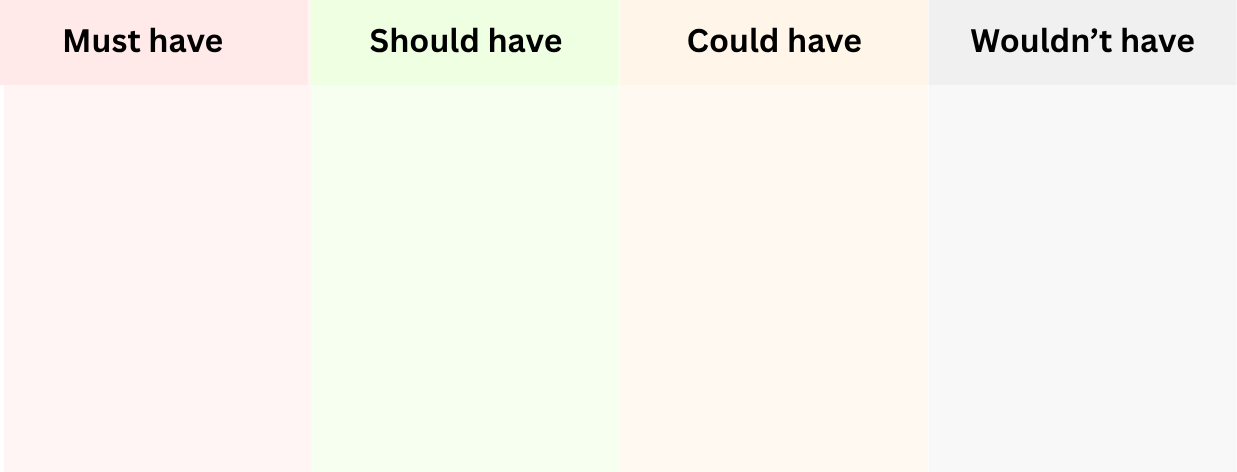
This tool is much easier to use. The principle is very simple and is reflected in the method’s name: Must_haveShold_haveCould_haveWon’t_have.
Must have
Critical activities (project tasks, projects, products, etc.) that must be completed for the survival (of a project, company, initiative, etc.).
Should have
These are important but not mandatory activities. The results may be of interest to stakeholders, so their implementation is desirable. Their implementation can, in principle, be postponed until a later date, but they are still necessary.
Could have
Low-priority activities. These are activities that can be implemented, but only if there’s free time.
Won’t have
During the allocated time period (e.g., the sprint in question, the calendar year, the five-year development plan, etc.), the activities will not be performed. There is either no time, no resources, or both.
MoSCoW usage
This mechanism is convenient to use due to its simplicity. However, unlike the Analytic Hierarchy Process, the assessment is more subjective, meaning it is difficult to use this tool to justify business decisions.
Recomendations
- When evaluating each activity, its significance must be fairly assessed. If all activities fall into the
Must havecategory, then the assessment is unfair. - Activity assessments must be based on specific criteria. For example,
Net Present Value,Earned Value Index,Schedule Index, stakeholder satisfaction, etc. - The MoSCoW model can be adjusted over time as priorities and the environment change.
MoSCoW process
It is somewhat similar to the Analytic Hierarchy Process:
- Define criteria. Important criteria that impact the goal (project, company, product, etc.) are listed.
- Create a MoSCoW Board similar to the one below:
- Activities requiring analysis are distributed across the board according to their assessment. Various methods can be used, but some systematic approach to assessment is desirable.
- Tracking ongoing activities
- Updating the board
Overall, this mechanism is overly simple and is better suited for accounting and monitoring activities. To assess the weight of activities, one can use the Principal Eigenvalue calculation, which is more fundamental and transparent.
Reach, Impact, Confidence, Effort (RICE)
A framework for estimating the expected impact of a given effort. Includes:
Reach- how many people will feel the effect of the adopted change. A timeline is not taken into account, only the impact itself;Impact- the expected magnitude of the impact. Typically, a numerical value within certain boundaries, often a fractional value from0to3. Transparency in impact assessment is important;Confidence- displays the confidence and validity of the estimates ofReach,Impact, andEffort;Effort- how much effort is required to achieve the goal. This should be measurable, such as cost of work or person-days.
Calculated as:
Example:
| R (users) | I | C (%) | E ($) | RICE Score | |
|---|---|---|---|---|---|
| Feature A | 100 | 2.25 | 80 | 1300 | 0.553 |
| Feature B | 1500 | 1.15 | 95 | 2500 | 0.655 |
| Feature C | 600 | 1.25 | 75 | 900 | 0.625 |
| Feature D | 1750 | 2.00 | 85 | 5000 | 0.595 |
The example shows that, according to the RICE Score, the following sequence is preferable: B -> C -> D -> A.
This tool is used when there is a certain level of knowledge about the team’s performance and the results achieved by completing a given task.
Impact, Confidence, Ease (ICE)
Similar to RICE, but the cost of work (Cost) is entered by the contractors themselves based on the complexity of the task, rather tentatively. Typically, this value ranges from 1 to 10. This tool is useful only in the early stages of project estimation, as it is very simple and quick.
Calculation method:
Weighted Shortest Job First (WSJF)
Used to deliver the highest-priority tasks to the user at the current moment. It is evaluated as follows:
where:
User/Business Value- the value of the change, from1(low) to10(high);Time Critical- the criticality of the implementation, from1(not critical) to10(critical);Risk/Opportunity- an assessment of the extent to which the change removes negative risks or increases positive ones, from1(remains risks) to10(removes risks);Job Size- the cost of the work, from1(cheap) to21(expensive).
For a fairer assessment, it is better to use the Fibonacci series: 0, 0.5, 1, 2, 3, 5, 8, 13, 21. This practice allows for more fair assessments, which, with the classic series from 1 to 10, subconsciously clusters assessments around 6-8.
The method is suitable for larger decisions involving a large number of participants. However, it requires an experienced evaluation team capable of providing fair and well-reasoned assessments.
Example:
| Value | Time | Risk | Job | WSJF Score | |
|---|---|---|---|---|---|
| Option A | 8 | 7 | 4 | 13 | 1.461 |
| Option B | 4 | 2 | 6 | 8 | 1.5 |
| Option C | 5 | 9 | 9 | 21 | 1.095 |
| Option D | 6 | 4 | 3 | 13 | 1 |
From the example it is clear that according to WSJF Score the following sequence is preferable: B -> A -> C -> D.
Value vs Effort Matrix
A matrix that is divided into four sectors based on priority:
Quick Wins– add a lot of value and are easy to execute;Major Projects– add a lot of value but are difficult to implement. Require planning;Fill-Ins– provide little value but are also undemanding;Thankless Tasks– bring no value and are very expensive.
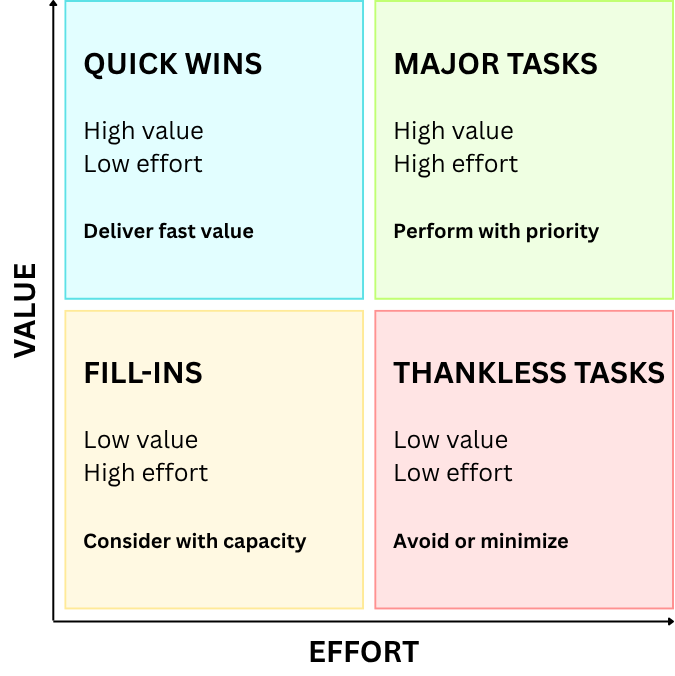
This assessment is simple and quick. It’s suitable for identifying tasks for the near future and distributing them among the appropriate categories.
Eisenhower Matrix
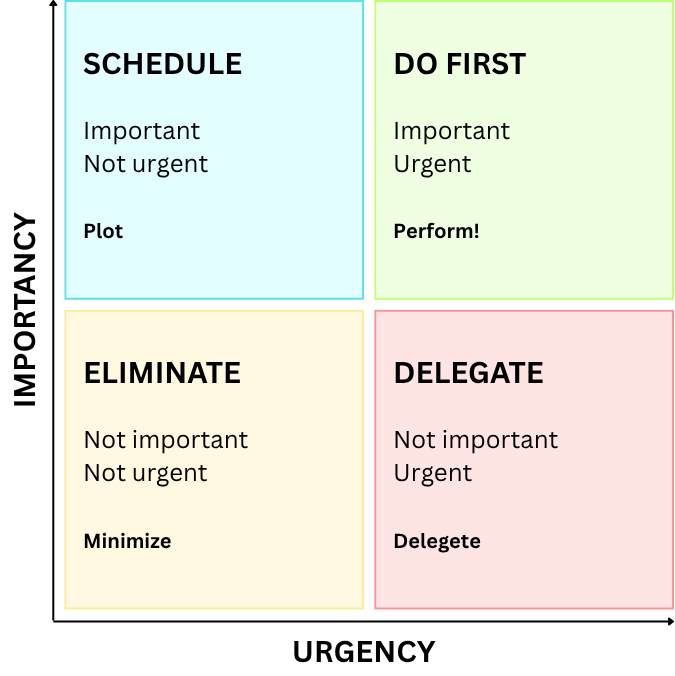
The matrix is similar to the Value vs. Effort Matrix, but it represents tasks on the Urgeny and Importance scales. It is used for daily tasks, operational activities, and personal planning.
Risk-Based Prioritization (RBP)
Task priorities are tied to the risks (usually negative) that failure to complete them creates. This allows the most risky tasks to be completed first. These risks are divided into Technical Risks, Market Risks, Compliance Risks, and Delivery Risks.
This tool is applicable to complex technological projects, projects subject to additional regulatory requirements, safety-critical systems, and the like—where risk mitigation is the top priority.
, where:
Impact- the cost of damage from the risk, from1(low) to5(catastrophic);Probability- the likelihood of the risk occurring, from1(low) to5(high);Urgency- the likelihood of occurrence to the current moment, from1(very far away) to5(very soon).
Kano Model
A measurement that evaluates task priorities based on user satisfaction. It is used in the earliest stages or during long-term planning. Its general features prioritize project or product development in relation to user expectations.
- A list of tasks is defined;
- For each task, two questions are asked:
- “How will the user feel if the feature is implemented?”;
- “How will the user feel if the feature is NOT implemented?”;
- Each answer is given a corresponding rating and one of the following Needs:
Attractive- the user will be pleasantly surprised if the feature is implemented, but its absence will not cause any particular discomfort;Performance- provides linear pleasure. A workhorse of tasks;Must-have- the user will be clearly dissatisfied;Indifferent- indifferent tasks that are not important to the user;Reverse- tasks that may irritate the end user.
- Tasks are distributed from Must-Be to Performance to Attractive.
How to optimize a product using Kano
- identify the functions that are most important to the user (
Must-haveandPerformance) and implement them; - define functions that are
Attractiveand plot them in the schedule; - avoid
IndifferentandReversetasks.
Affinity Mapping
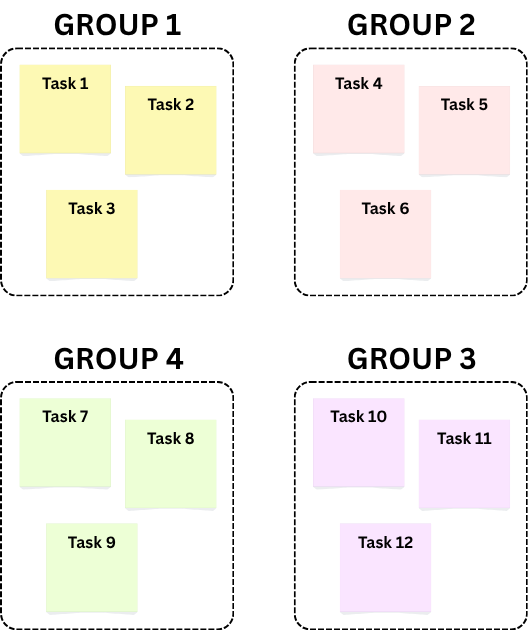
Tasks are grouped by areas they can be assigned to. This helps the team develop a clearer vision of the big picture and the entire product. It’s convenient to use in the early and nascent stages. Affinity Mapping is typically used later for actual estimations using other tools.
Jobs-to-be-Done
The assessment is based not on the question “What feature needs to be created?”, but on the question “How does the user currently do it? What are they unhappy with? How can this be fixed?” This assessment is also vectorial in nature—it directs the project’s development toward meeting the user’s actual needs.
Actual assessment should also be conducted using other tools.
What to choose?
| Situation | Framework |
|---|---|
| Release planning with the business | MoSCoW |
| Estimation based on existing experience | RICE |
| Rapid assessment | ICE |
| Estimation of a product from the company’s portfolio | WSJF |
| Long-term planning with the team | Value vs Effort Matrix |
| Personal planning | Eisenhower Matrix |
| Estimation for stakeholder | Analytic Hierarchy Process |
| Projects with high risk concentration | Risk-Based Prioritization |
| Using user satisfaction assessment | Kano Model |
| General task map with grouping | Affinity Mapping |
| Estimation of business user needs | Jobs-to-be-Done |
Recomendations
- Assessments should not be the sole basis for decision-making; they are merely an aid to ranking;
- Assessments must be objective and fair;
- Repeated recalculation helps improve assessment fairness;
- The more diverse and high-quality opinions are included in the assessment, the fairer it will be;
- Prioritization of tasks may change on the business side, meaning assessments should be regularly reviewed.